
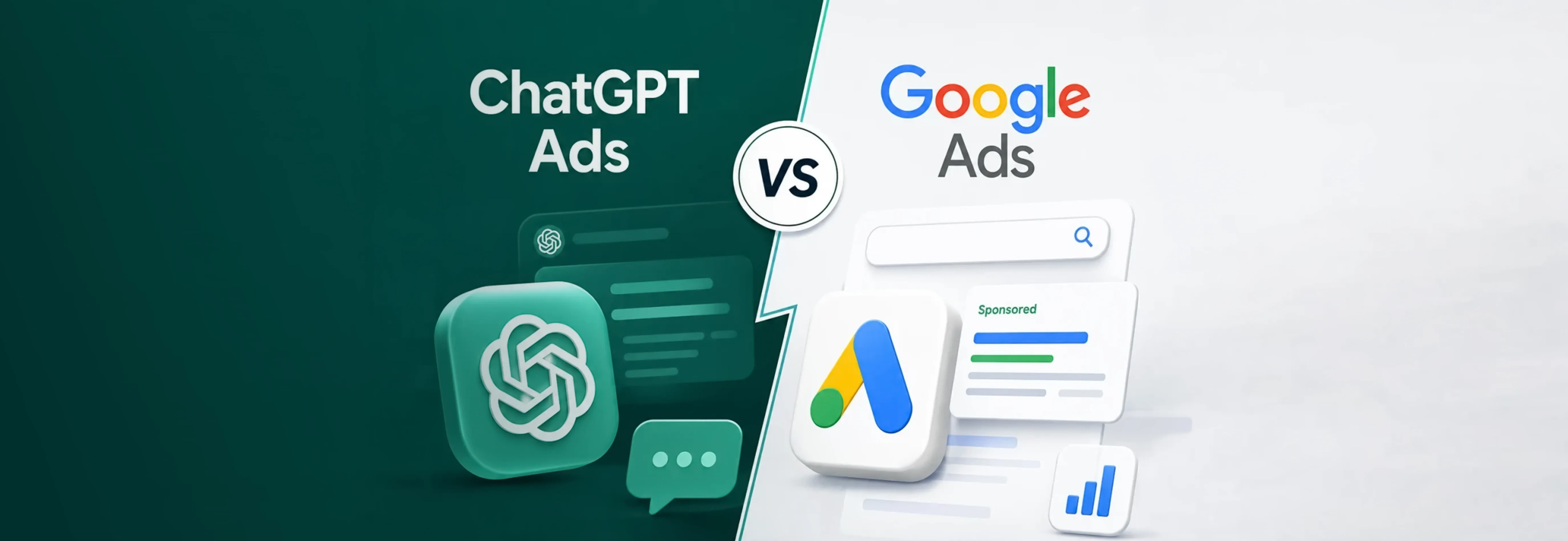
ChatGPT Ads vs Google Ads: What’s Changing in 2026?
Reading Time: 10 min
 Share this article
Key Takeaways
- ChatGPT Ads and Google Ads are shaping digital advertising in 2026.
- Explore their key differences, targeting methods, customer journey impact, and how UAE businesses can use both platforms to improve campaign performance.
- Why Does This Matter in 2026?
- How Do ChatGPT Ads Work?
- ChatGPT Ads and Google Ads
Why Does This Matter in 2026?
Nowadays, people do not rely on searching in one place anymore. There are people who both still rely on Google when they are in need of a service or a product or use an AI tool to ask questions about their needs. For example, they may search for “Google Ads Dubai” or “Performance marketing agency in UAE.”
Whereas when using an AI tool, they start by asking a question such as, “Which performance marketing agency in UAE is good for a real estate company?”
This is where ChatGPT Ads may help. A relevant business option can appear while the person is still learning and comparing options. From the perspective of a performance marketing agency in UAE, this means marketing is changing.
The scale of this shift is becoming clearer. In its 5 October 2026 announcement, OpenAI said ChatGPT reaches 1.2 billion people each week. However, this is the platform’s overall audience and not the number of people eligible to see ads or the advertising audience available in the UAE. The figure shows why businesses are paying attention to conversational platforms since actual campaign reach still depends on market availability and user eligibility.
How Do ChatGPT Ads Work?
ChatGPT Ads are paid ads shown near a ChatGPT answer. OpenAI says these ads are clearly marked as sponsored and stay separate from the normal answer. The ads do not change what ChatGPT says in its response.
OpenAI matches ads with the topic of the conversation. It may also use past chats and past ad activity to make the ad more relevant to the user. In regards to privacy concerns, advertisers do not get access to a user’s private chats or personal details.
ChatGPT Ads have also introduced more ways to buy and measure campaigns. On 5 May 2026, OpenAI announced cost-per-click bidding alongside its existing cost-per-thousand-impressions buying option. It also reported the introduction of a Conversions API and pixel-based measurement, allowing advertisers to measure actions such as purchases and sign-ups after an ad interaction. This gives businesses a way to assess outcomes beyond views and clicks as the platform develops.
For example, a user may ask ChatGPT for healthy meal ideas and will then proceed to see an ad from a meal-delivery service. Basically, the ad should relate to what the user is discussing.
The boundaries of ChatGPT Ads are expanding. OpenAI has also started testing visual ads during image generation requests. They also follow the same rule of being labelled as sponsored and being kept separate from the normal image created.
ChatGPT Ads and Google Ads
| Area | ChatGPT Ads | Google Ads |
|---|---|---|
| Where ads appear | During a ChatGPT conversation | Google Search, YouTube, Display, Shopping and other Google spaces |
| Why a person sees the ad | The ad matches the conversation. | The person searches for a word, product or service |
| User stage | Research and comparison | Often ready to enquire, call or buy |
| Main strength | Helps people find brands while exploring options | Helps businesses reach people with clear search intent |
| Targeting | Related to the conversation topic and available ad signals | Keywords, location, audience, device, remarketing and more |
| Reporting | Still growing as the platform develops | Strong reporting, conversion tracking and bidding tools |
| Best use | Brand discovery | Leads, sales and local enquiries |
Where Do Google Ads Fit in the Customer Journey?
Google Search Ads can help businesses reach people actively searching for a product or service. Someone searching for “digital marketing agency Dubai,” for example, may already be considering an agency. A relevant ad can connect that person with the business and its service page. Rather than assuming Google Ads will always outperform ChatGPT Ads, businesses should compare the results against their own campaign goals.
Google Ads are useful for:
- Getting business leads.
- Promoting local services..
- Sending people to a product page.
- Driving calls and WhatsApp enquiries.
- Running ecommerce campaigns.
- Reaching people again through remarketing.
- Tracking form fills, calls, sales and other actions.
Above all else, Google Ads primarily give businesses more control in choosing keywords, locations, budgets and audiences. You can also block unwanted search terms with negative keywords. For most UAE businesses, Google Ads should remain an important part of lead generation.
So Where Can ChatGPT Ads Help?
ChatGPT Ads can help when people are still learning and are not yet decided on using a service or buying a product. They might be comparing different options by asking for advice before they search on Google. This is particularly useful for businesses that sell services or products that need more thought before purchase.
Examples include:
- Marketing agencies.
- Real estate companies.
- Education providers.
- Legal services.
- B2B software companies.
- Healthcare brands, where platform rules allow advertising.
- High-value products and services.
ChatGPT Ads may help a business become familiar to a customer before they search for the brand on Google.
Which Platform Should You Use?
| Platform or research area | Reported statistic | What it helps explain | Important limitation |
|---|---|---|---|
| ChatGPT audience | OpenAI reported 1.2 billion people reached each week in October 2026. OpenAI. | The scale of the conversational platform. | Overall audience is not the same as ad-eligible audience or UAE campaign reach. |
| ChatGPT Ads: WeightWatchers | Attributed cost per acquisition was 15.3% lower than its blended paid-search benchmark, according to DV Rockerbox. OpenAI. | An early example of acquisition performance. | One advertiser’s result; not a Google Ads-only or platform-wide comparison. |
| ChatGPT Ads: Portland Leather | 93% of visitors from ChatGPT Ads were new, according to Triple Whale. OpenAI. | Potential to reach people who have not previously visited the brand. | New visitors are not necessarily new customers or completed purchases. |
| ChatGPT Ads: Dose | 67% of incremental purchases came from net-new customers, according to WorkMagic. OpenAI. | Potential to generate additional purchases from new customers. | A brand-specific result, not a universal conversion benchmark. |
| Search advertising: overall | 6.64% click-through rate; US$5.42 cost per click; 8.18% conversion rate; US$66.69 cost per lead. Wordstream. | Reference points for search-campaign performance. | US-based Google and Microsoft search-advertising sample; figures are medians, not UAE forecasts. |
| Search advertising: real estate | 3.70% conversion rate and US$102.51 cost per lead. Wordstream. | How industry economics can differ from overall benchmarks. | Same US-based dataset; local competition and lead quality may differ. |
| Search advertising: education and instruction | 13.14% conversion rate and US$77.48 cost per lead. Wordstream. | Why sector-specific targets are more useful than one universal target. | Same US-based dataset; conversion definitions vary by campaign. |
| Google search behaviour | Traditional result links were clicked in 8% of visits with an AI summary, compared with 15% without one. Pew Research Center. | How AI summaries can change onward website visits. | Observational US research on search behaviour, not a paid-ad performance comparison. |
These figures should be read as separate evidence points, not as a head-to-head platform test.
For Example
Imagine a company that offers website development in Dubai. A person may search Google for:
“Website development company Dubai”
Google Ads will show the company’s ad because this person is looking for that particular service.
Another person may ask ChatGPT:
“What are the things I should check before hiring a website development company?”
A relevant ChatGPT Ad may help that same company appear earlier. The user may later search the company name on Google or visit its website. This is how these two platforms can work together.
Digital Advertising Trends in 2026
However, AI is undoubtedly changing how people look for information. Some people now ask AI tools before searching on Google. Although, this does not mean Google search is going away. It simply requires businesses to appear in more places than they usually would.
Research on Google search behaviour helps explain why visibility and website traffic are no longer the same thing. Pew Research Center’s July 2025 study analysed browsing data from 900 US adults, covering 68,879 unique Google searches. Users clicked a traditional search result in 8% of visits when an AI summary appeared, compared with 15% when no AI summary appeared. Links within the AI summaries themselves were clicked in just 1% of visits to pages containing a summary.
Longer, question-led searches were also more likely to produce AI summaries. In the study, 53% of searches containing 10 words or more generated an AI summary, compared with 8% of searches containing one or two words. This is relevant to digital advertising trends in 2026 because it shows how detailed research queries can lead to a different search experience. However, these findings concern Google AI summaries and not ChatGPT ad click. Therefore, this should not be used to predict paid campaign conversion rates
These are certain trends to watch for:
- More people will use AI tools to compare products and services.
- Google Ads will use more automation and AI features.
- Good customer data will become more important.
- Businesses will test more ad versions with AI tools.
- Tracking will need to look at more than one click.
To sum it up, a customer may first see a brand in a ChatGPT response. Later, they may search the brand name on Google and proceed to contact the business through a website form or WhatsApp if they are ready.
How Can UAE Businesses Use Both ChatGPT Ads and Google Ads?
A good plan could look like this:
- Use Google Ads for service keywords with clear buying intent.
- Create useful landing pages for each key service.
- List the common questions customers ask before they are ready to buy.
- Test ChatGPT Ads around those questions when the platform is available for the target market.
- Use the same brand message across both channels..
FAQs
Are ChatGPT Ads available in the UAE?
OpenAI began testing ChatGPT Ads in the United States. It later expanded pilots to countries including the United Kingdom, Mexico, Brazil, Japan and South Korea. OpenAI has said it plans to expand further, but UAE availability should be checked before planning a campaign.
Are ChatGPT Ads shown to every user?
No. OpenAI says ads are currently linked to the Free and Go tiers. Plus, Pro, Business, Enterprise and Education users do not see ads.
Do ChatGPT Ads change ChatGPT answers?
No. OpenAI says ads do not affect ChatGPT’s answers. Sponsored ads are labelled and shown separately from the normal answer.
Can ChatGPT Ads replace Google Ads?
Not necessarily. The platforms offer different ways to reach potential customers. Google Ads connect businesses with people searching for relevant products or services, while ChatGPT Ads can reach people as they explore questions and compare options. ChatGPT Ads have also shown early advertiser-specific acquisition results, so their role is not limited to awareness. Whether either platform should take a larger share of the budget depends on availability and the business’s measured results. There is no universal claim that one is better.
Can ChatGPT Ads replace SEO?
No. Ads are paid placements whereas SEO helps a website appear in a Google search and may also help a brand become a useful source for AI search results. Businesses should work on both paid ads and organic visibility.
Final Thoughts
ChatGPT Ads offer businesses another way to reach people as they compare options and make decisions. Google Ads can remain part of the same marketing strategy instead of being treated as a competing channel that must either win or lose.
For UAE businesses, the choice should depend on platform availability and measured outcomes. Performance marketing agencies in UAE can help test the available channels and compare customer acquisition costs and sales.
Other Blogs
AI-Generated Ads vs Human-Created Ads: Which Performs Better?
Read More
Why AI Search Platforms Keep Changing Their Sources: A Guide to Tracking Brand Visibility and Citations
Read More
Google Ads Updates 2026: AI Max, Smart Bidding and Campaign Automation
Read More
Instagram's New 90-Minute Videos: Are Reels Becoming Trailers for Long-Form Content?
Read More
The DHA “Banned Words” List: A Content Checklist for Clinic Social Media Teams in Dubai
Read More
Meta’s Muse vs. ChatGPT Agents vs. Google Gemini: How the AI Agent Race Affects Marketers
Read More
AI vs Human Designers: What Makes Great Design Stand Out?
Read More
Branded GEO: Take Control of Your AI Brand Presence Before Competitors Do
Read More
What to Expect from an AI SEO Agency: Services, Costs, and Real ROI
Read More
Developing Custom Marketing Agents: A Digital Marketing and Advertising Agency Blueprint
Read More
Meta's New Ad Features in 2026 and How to Use Them
Read More
Google I/O 2026 vs Google I/O 2025: What has Changed?
Read More
Wisoft Solutions Becomes an Official Odoo Partner in Dubai
Read More
Maximizing Revenue on Facebook: Proven Strategies for Effective Advertising and Sales Growth
Read More
Unlocking Growth: How CRM Empowers Small Businesses in the Digital Age
Read More
Navigating the Future: Google SGE and Its Impact on Digital Marketing Companies in the UAE
Read More
Call to Actions (CTAs) for Digital Marketing Success in Dubai
Read More
Google Algorithm Changes : The Complete Evolution
Read More
Turn Chats into Conversions: Smart WhatsApp Setup Hacks for Businesses
Read More
Why Lead Quality Beats Lead Quantity Every Time
Read More
AI SEO Strategies Explained: How it is important for brand visibility?
Read More
Before You Run Ads: 5 Critical Checks Every Business Must Do
Read More
Stop Wasting Money on Vanity Metrics: The ROI Formula Every Healthcare SME Needs
Read More
What Makes an E-commerce Store Trustworthy?
Read More
13 Ways To Detect AI Written Content
Read More
Amazon PPC: The Ultimate Guide for 2024
Read More
Keywords Unmasked: Branded vs. Non-Branded Battle
Read More
Treat Your Website Like a Salesperson and Here’s How to Turn It Into a Lead-Generating Machine
Read More
From Clicks to Classrooms: How We Helped One of the Top UK Universities Hit Every EMBA Intake Target—Five Times Running
Read More
Google I/O 2025 SEO Strategy: How AI Is Transforming Search
Read More
Creating an Educational Website Wireframe for SEO
Read More
Healthcare Lead Generation: Connecting Providers with Potential Patients
Read More
How to Brand Your Business in 7 Simple Steps (with Examples!)
Read More
A Detailed Guide To Website Page Speed
Read More
10 Essential Factors to Create an Outstanding E-Commerce Website
Read More
Digital Marketing OR Traditional Marketing? Which Is Better?
Read More
Strategies for Optimizing Your Website for Voice Search to Stay Ahead of the Trend
Read More
Plan Once, Post All Month: The 1-Hour Content Strategy That Works
Read More
Free vs Paid Tools: Comparing the Best Options Every New Entrepreneur Should Try
Read More
How Consistent Branding Online Builds Customer Trust
Read More
SEO for Finance Companies: A Comprehensive Guide to Driving Digital Growth
Read More
Best Social Media Platforms for Business in 2025
Read More
Global Healthcare Industry: Market Landscape and Search Trends
Read More
Why Do Reviews of Google My Business and Google Business Profiles Matter for Local SEO in Dubai?
Read More
Wisoft Solutions and Their Remarkable Achievement at the MENA Search Awards
Read More
Content Repurposing: What It Is and Why It’s Essential
Read More
The Future of Marketing Analytics: How DeepSeek AI is Changing the Game
Read More
Facebook Split Testing (A/B Testing) Guide: Unlocking Data-Driven Success for Your Campaigns
Read More
Different Types of Google Ads and When To Use Them
Read More
How Marketers Are Spending Their Money in 2025
Read More
12 Outdated SEO Practices Still Killing Rankings in 2026 (And What to Do Instead)
Read More
A Comprehensive Website Migration Checklist
Read More
Recap of the Google Algorithm Updates in 2025
Read More
How to Use a People Also Ask Section to Get More Traffic
Read More
How We Helped Rahhalah Explorers Achieve Half a Million Reach
Read More
SEO in 2026: Future Predictions and Trends
Read More
How to Improve Your Email Open Rates
Read More
10 Follow-Up Techniques That Close More Deals
Read More
Search Google or Type a URL: Which Gives Better Results?
Read More
How to Use Behavioural Psychology to Drive Marketing Success
Read More
Best Times to Post on Social Media in 2026
Read More
Top JavaScript Frameworks for SEO-Friendly Websites
Read More
10 Proven Strategies to Reduce E-commerce Cart Abandonment
Read More
A Quick & Practical Guide to Google Local Service Ads
Read More
Elevate Your E-commerce Strategy with SEO in 2025
Read More
How Customer Feedback Can Shape Your Entire Marketing Strategy
Read More
10 Steps for Startup Founders to Build a Personal Brand on Social Media
Read More
11 Game-Changing Insights to Drive Startup Business Success in 2025 and Beyond
Read More
Startup Success: How Positive Work Culture Drives Employee Wellness and Productivity
Read More
Top 20 Branding Strategies for Law Firms
Read More
Maximising Travel Bookings with PPC Advertising: A Comprehensive Guide
Read More
What Is Digital PR and How Can It Impact My Business?
Read More
The Difference Between Keywords and Search Queries
Read More
How To Assess Startup Performance: 19 Crucial Indicators To Pay Attention To
Read More
Why Isn’t Google Indexing My Page? 14 Reasons to Know!
Read More
Google Ads Vs. Facebook Ads: Which Is Best For Your Business In Dubai?
Read More
How to Conduct a Social Media Audit in 9 Simple Steps
Read More
Boosting Real Estate Leads with PPC Advertising in 2025
Read More
The Power Of Remarketing In PPC Advertising
Read More
GPT-3.5 and GPT-4: Choosing the Right ChatGPT for Your Business Needs
Read More
The 10 Core Graphic Design Principles Every Designer and Marketer Must Know
Read More
Understanding Negative Keywords: Definition and Practical Implementation
Read More
The Rise of Mobile Commerce: Understanding Consumer Behavior in a Mobile-First Era
Read More
Checklist for Designing Your Website in 2026
Read More
Real Estate Digital Marketing Trends for 2026 : Trends, Strategies, and Innovations
Read More
Ultimate Guide for Healthcare SEO: Medical SEO Tactics
Read More
How Does WhatsApp Integration Help Your Website?
Read More
Beyond Clicks: Tracking the True Value of Your Paid Ads in Dubai
Read More
Content Castle: Building Websites that Convert with SEO Moats and Social Bridges
Read More
Marketing with AI vs Humans: Striking the Right Balance of Automation & Creativity
Read More
Local SEO: Dominating with Google My Business and Hyperlocal Tactics in Dubai
Read More