

AI SEO Services in Bangalore to Get Your Brand Cited and Suggested by AI Search
Search has changed. Buyers now start on ChatGPT, Perplexity, Gemini, and Grok, while Google AI Overviews are absorbing the clicks that used to go to organic results. The brands cited by AI are not the ones chasing trends; they are the ones with genuine authority, structured content, and technical credibility. Traditional SEO builds the foundation. AI visibility builds on top of it. We help Bangalore businesses achieve both.
 Generative Engine Optimisation (GEO)
Answer Engine Optimisation (AEO)
LLM content optimisation







Why Your Organic Traffic Is Changing and What to Do About It
Search behaviour is shifting faster than most businesses have updated their strategy. Three things are happening simultaneously.

AI platforms are becoming the first stop for research
58% of users now use AI tools like ChatGPT for search-like queries. 70% of Gen Z prefers conversational search. Buyers are arriving at a shortlist, sometimes a single recommendation, before they ever open Google. If your brand is not being cited in those AI-generated answers, you are invisible at the earliest stage of the decision process.

AI Overviews are absorbing clicks that used to reach organic results
25% of all Google searches now show an AI Overview. When Gemini's AI Mode surfaces an answer, 93% of those searches end without a click to any website. The traffic that traditional SEO used to deliver reliably is being intercepted before it reaches the organic results.

The brands being cited are not new to this
80% of ChatGPT's citations do not rank in Google's top 100. AI platforms are not pulling from the most recently optimised pages. They are pulling from sources with demonstrated authority, structured content, original data, credible citations, and a track record of answering questions comprehensively. The brands winning AI visibility built their foundation over years, not months.

AI-referred traffic is growing faster than any other channel
AI-referred sessions grew 527% year on year. Perplexity processes 1.5 billion queries per month, up 370% year on year. ChatGPT Search alone drives 87% of all AI referral traffic. This is not an emerging trend. It is an active redistribution of search traffic that is already affecting organic performance across categories.
This is the gap we help Bangalore businesses close. Not by chasing AI as a trend, but by building the content authority, technical infrastructure, and entity signals that AI platforms are designed to surface.
AI SEO Services in Bangalore, Each Targeting a Specific Gap in Your AI Visibility
Every service we offer exists because a gap in your AI search presence is costing you visibility at the moment a buyer is forming their consideration set. Here's what we cover and why each piece matters.
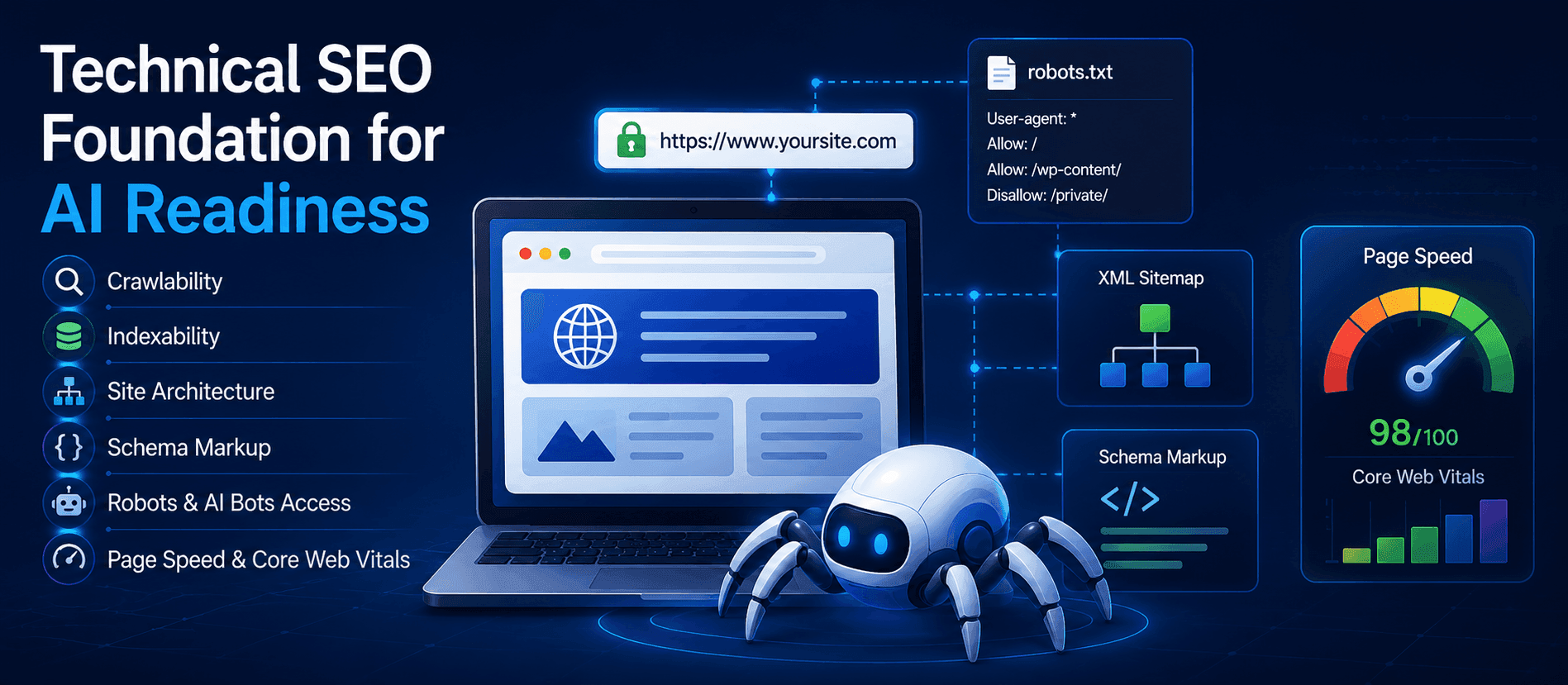
The problem: AI platforms read your website the same way search engines do, and they are equally unforgiving of technical problems. A site with slow load times, broken internal linking, missing schema, or poor crawl architecture will not be cited by AI models regardless of content quality. You cannot build AI visibility on a technically broken foundation.
What we do: Full technical audit covering Core Web Vitals, crawlability, indexation depth, schema markup implementation (FAQ, HowTo, Article, Organisation, and local schema), mobile performance, site speed, and internal linking hierarchy. We map the pillar-to-subpage architecture that helps AI models understand your site's topical scope, the same way our own SEO service page links to technical analysis, local SEO, link building, and content optimisation sub-pages. This interlinking signals to AI crawlers exactly what category you operate in and how deeply you cover it.
Pro tip - Google AI Overviews pull directly from top-ranking organic pages, which means rankings still drive AI visibility on Google. If your site has significant technical debt, fix that first. No amount of GEO content will produce citations on a technically broken foundation.
Technical SEO Foundation for AI Readiness
The problem: AI platforms read your website the same way search engines do, and they are equally unforgiving of technical problems. A site with slow load times, broken internal linking, missing schema, or poor crawl architecture will not be cited by AI models regardless of content quality. You cannot build AI visibility on a technically broken foundation.
What we do: Full technical audit covering Core Web Vitals, crawlability, indexation depth, schema markup implementation (FAQ, HowTo, Article, Organisation, and local schema), mobile performance, site speed, and internal linking hierarchy. We map the pillar-to-subpage architecture that helps AI models understand your site's topical scope, the same way our own SEO service page links to technical analysis, local SEO, link building, and content optimisation sub-pages. This interlinking signals to AI crawlers exactly what category you operate in and how deeply you cover it.
Pro tip - Google AI Overviews pull directly from top-ranking organic pages, which means rankings still drive AI visibility on Google. If your site has significant technical debt, fix that first. No amount of GEO content will produce citations on a technically broken foundation.
LLM Optimisation and Content Architecture
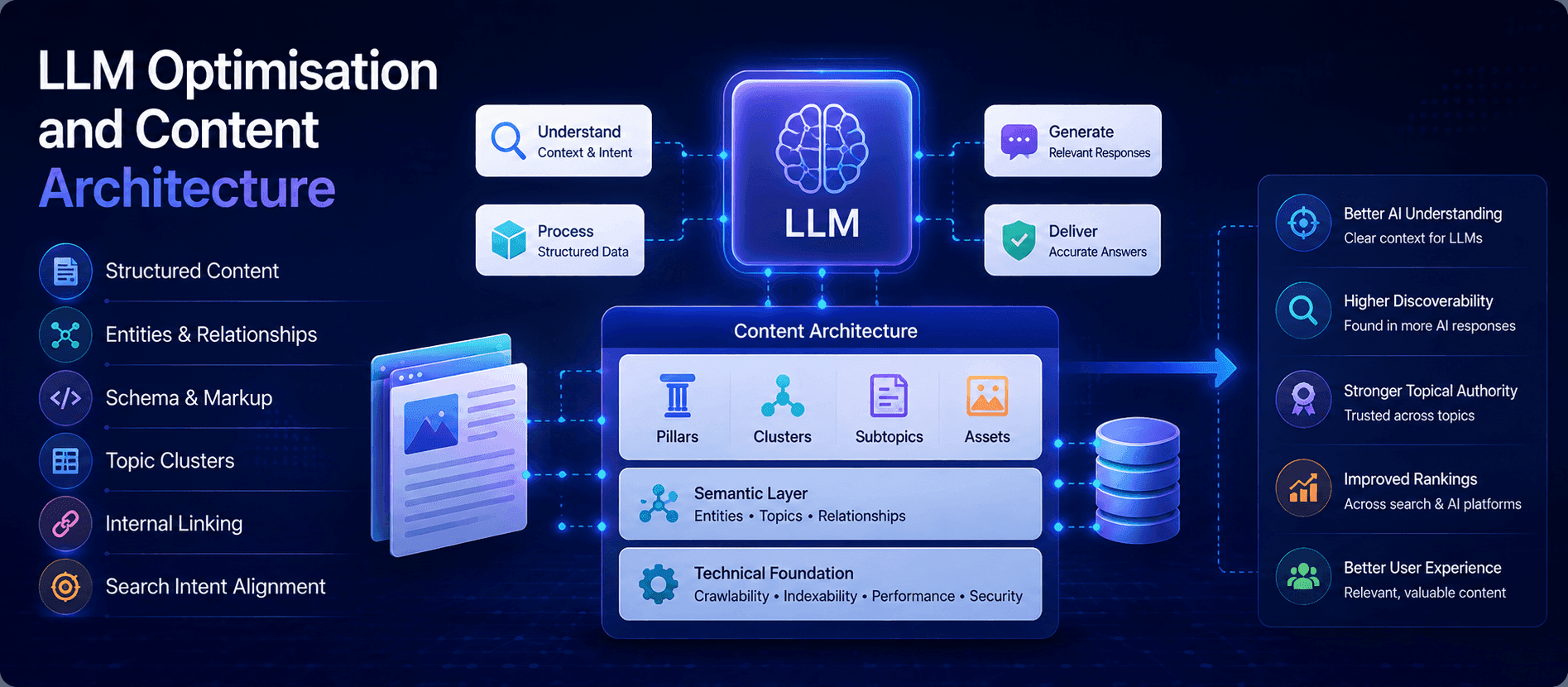
The problem: LLMs (Large Language Models) do not search the way humans do. When someone queries "best digital marketing agency in Bangalore," the model breaks that phrase into conceptual fragments, searches its training data for each, and assembles an answer from sources it has indexed as authoritative across all of them. If your content does not demonstrate authority across the full semantic territory of your category, the model will not reach for it.
What we do: Content architecture that builds topical authority across the full scope of your category. We identify every concept, question, and semantic cluster your buyer might query, then create or restructure content to own that territory. Content demonstrates expertise, not just keyword presence. Internal linking connects every piece back to the authoritative pillar, so AI models recognise the site as a primary source, not a page that mentions the right words.
Pro tip - AI models reward subject depth over individually optimised pages. A single landing page targeting one keyword will not earn citations. A content architecture that answers the full range of questions your buyer might ask will.
GEO Content Strategy (Generative Engine Optimisation)
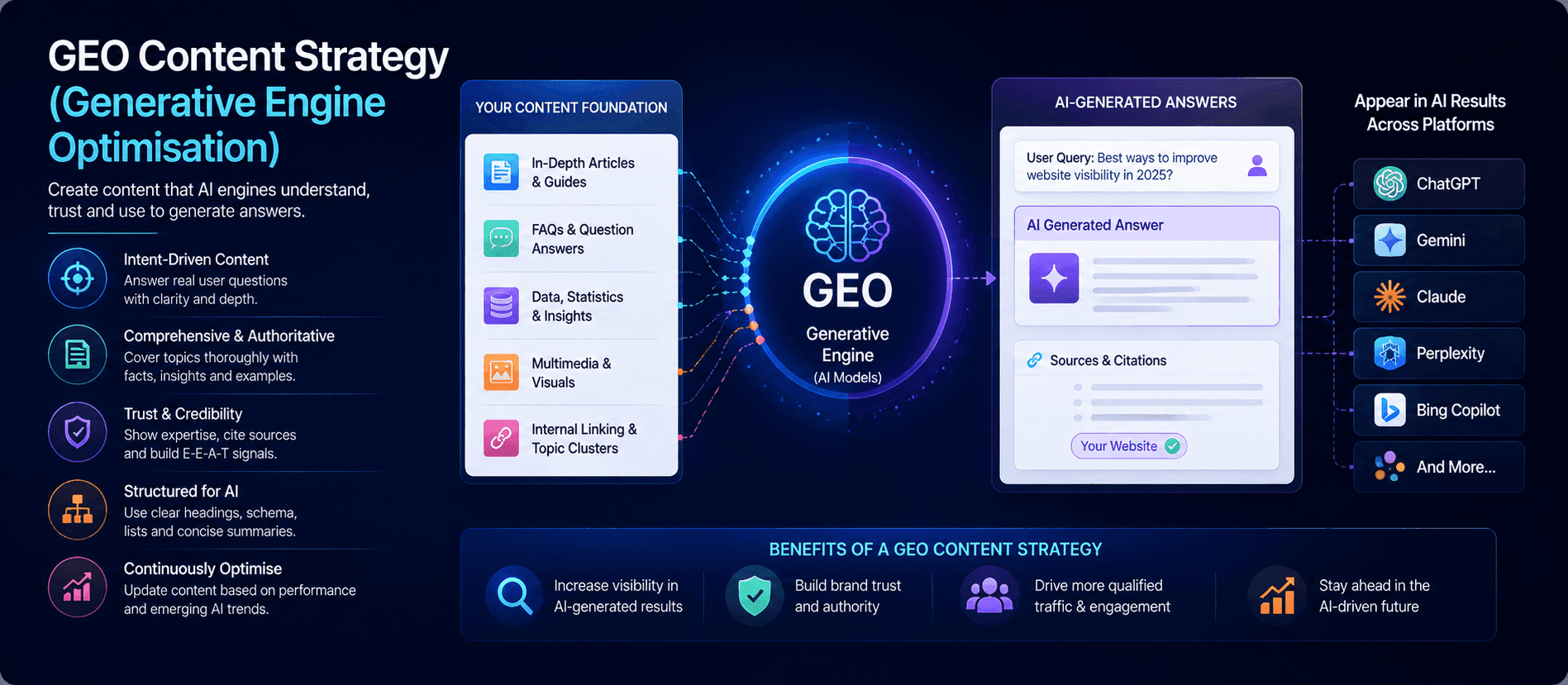
The problem: SEO content is written for keyword density and ranking signals. GEO content is written to be cited as an answer. The format, structure, and way claims are substantiated are fundamentally different. Most businesses are producing SEO content and wondering why they are not appearing in AI-generated answers. It was not built for that purpose.
What we do: GEO content across every format AI models surface as authoritative answers: how-to guides that match intent-driven queries, FAQ content structured around natural language prompts, expert opinion pieces with depth and human perspective, comparison content that helps AI present clear choices, case studies rich in real-world context and original data, and digital press releases that update the knowledge graph with current, official brand information. Every piece is built with cited, credible sources because AI models treat citation credibility as a trust signal. Content is written in answer format from the first word. Context-rich explanations covering related semantic clusters, not just the target keyword. Clear definitions and summaries the model can extract directly. Data and statistics with source attribution. Tables and infographics where relevant, because structured, scannable content is weighted as higher credibility. All GEO content is written in plain, readable language because AI platforms are trained on how people naturally ask questions. Dense technical language is less likely to be surfaced as a direct answer than content written the way a knowledgeable person would explain something to a non-specialist.
Pro tip - Especially relevant for SaaS, healthcare, education, real estate, legal and financial services, and B2B technology, where buyers ask complex, research-heavy questions before making a decision.
Answer Engine Optimisation (AEO)
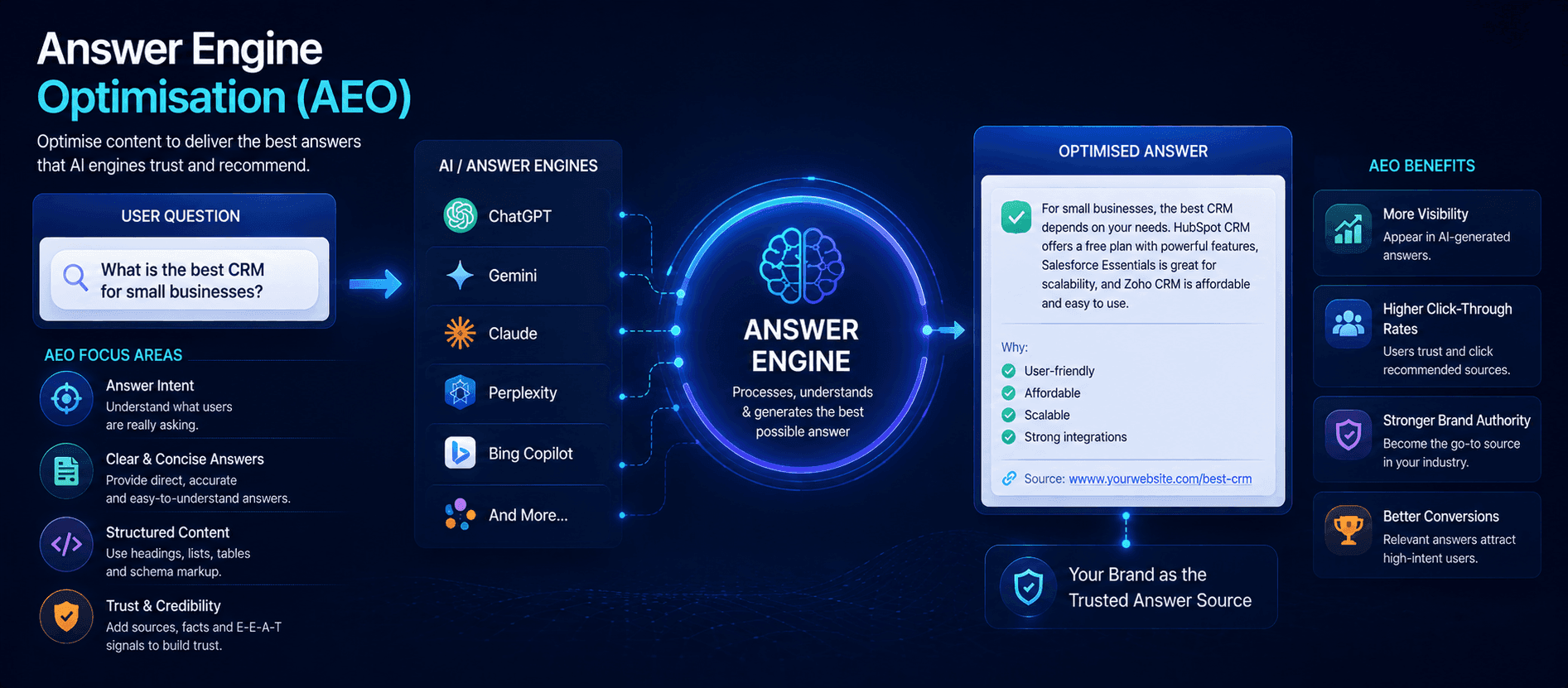
The problem: When someone asks ChatGPT, Perplexity, or Gemini a direct question, the platform generates a single answer, not ten blue links. The brand in that answer owns that query. Most businesses have not structured their content to compete at this layer because it did not exist three years ago.
What we do: We identify and reverse-engineer the prompts your buyers are using across AI platforms, map the questions they ask at each stage of the decision journey, and engineer content that answers those prompts in the format AI models prefer. Content is written to be extractable: a model should be able to pull a paragraph and present it as a direct answer without rewriting it. Schema markup, clear definitions, structured data, and question-and-answer formatting are built in throughout. We track which prompts your brand is being surfaced for and which competitors are occupying the citations you should be winning.
Pro tip - Especially relevant for high-consideration categories where buyers ask complex questions before deciding, and for any brand that wants to be the source an AI cites when a buyer asks "what is the best [category] in Bangalore?"
Platform-Specific AI Visibility Strategy
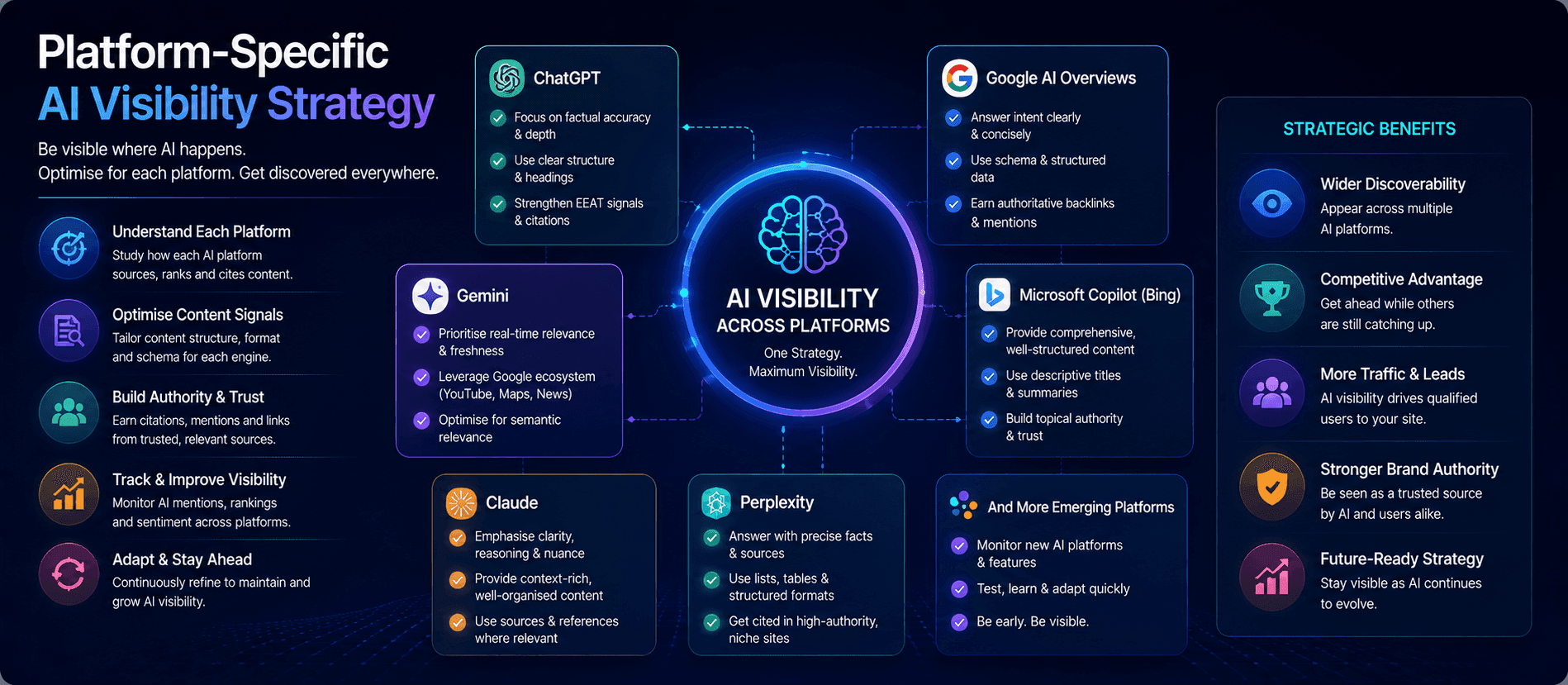
The problem: Different AI platforms source and weight content differently. Optimising for Google AI Overviews requires different inputs than optimising for ChatGPT Search or Perplexity. A single content approach applied uniformly across all platforms will underperform on most of them.
What we do: Platform-specific strategy built around how each AI model sources and weights content. Google AI Overviews Pulls from top-ranking organic pages. Schema markup (FAQ, HowTo) boosts inclusion. Core Web Vitals matter. The path to AI Overview citations runs directly through traditional SEO rankings. For Bangalore-specific local visibility, Google AI Overviews and Gemini are the primary targets, both fed by technical SEO, local schema, and GBP signals. ChatGPT Search Drives 87% of all AI referral traffic. Rewards encyclopedic, well-structured content with strong E-E-A-T signals and named authorship. 80% of its citations do not rank in Google's top 100, which means domain authority and content depth matter more than current ranking position. Perplexity AI 1.5 billion queries per month, 370% year-on-year growth, highest citation-per-search rate at 13.8%. Rewards recency, original data, and first-hand specificity. Publishing original statistics, research, and timely commentary is the primary lever for Perplexity citations. Gemini and AI Mode 750 million monthly users. Closely tied to Google's traditional ranking signals. Local schema and Google Business Profile signals feed Gemini for location-based queries. 93% of AI Mode searches end without a click to any website. Grok, Claude, and Microsoft Copilot Each has its own indexing and sourcing logic. Covered within the full audit scope across all active AI platforms your buyers are using.
Pro tip - For Bangalore-specific local visibility, focus on Google AI Overviews and Gemini first. For national or global competition, ChatGPT Search and Perplexity require dedicated content and authority strategies.
Semantic Keyword and Topical Context Building
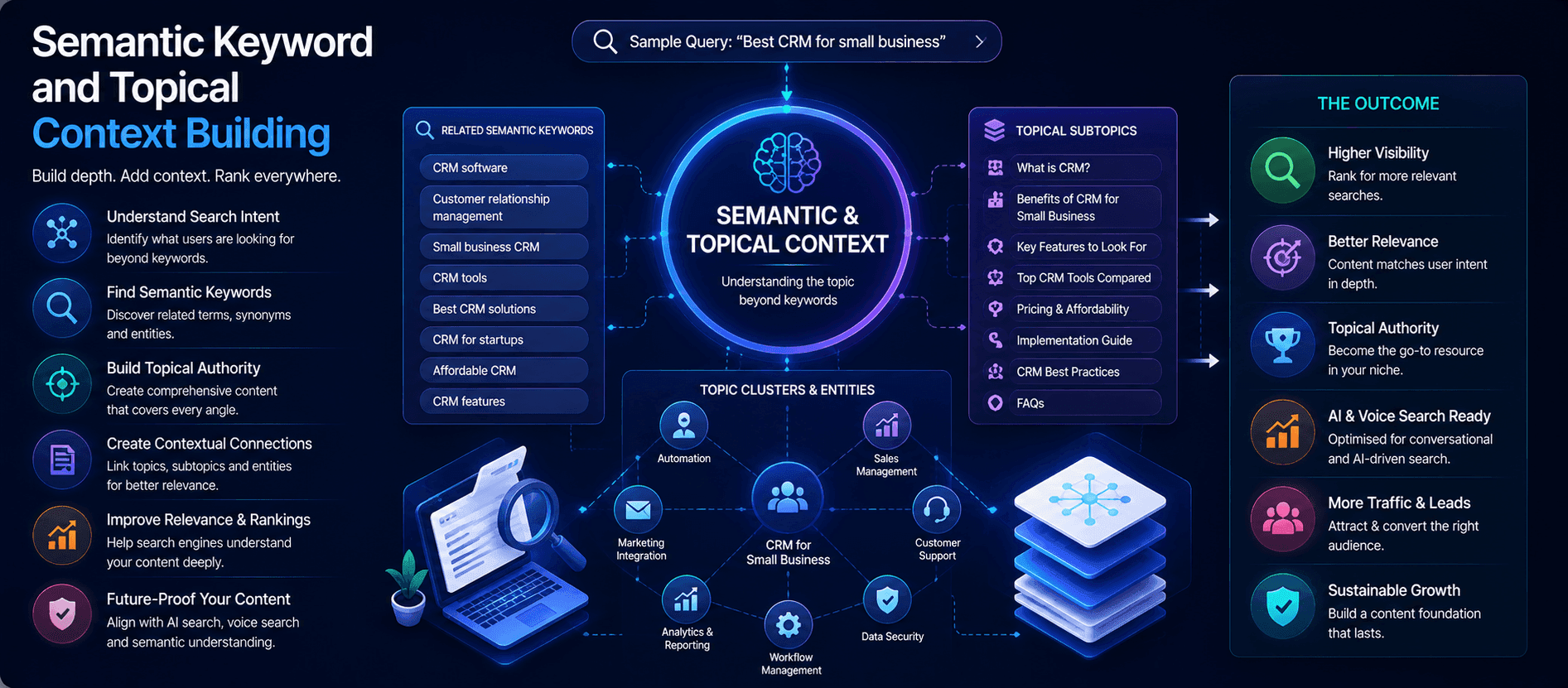
The problem: AI models do not read keyword density. They read semantic coherence: how well content demonstrates genuine understanding of a topic across all its related concepts. A page that mentions "digital marketing agency" seventeen times but never discusses attribution, funnel strategy, or campaign architecture does not read as authoritative to an LLM.
What we do: Semantic keyword mapping across the full topical territory of your category. We identify the complete cluster of related terms, concepts, entities, and questions your buyer might query, then ensure your content covers them with the depth that signals expertise. When a buyer searches "performance marketing agency in Bangalore," the AI evaluates whether your content demonstrates understanding of CPL optimisation, ROAS, attribution modelling, and funnel architecture, not just whether you used the phrase enough times. Readability matters equally. Content written in plain, everyday language mirrors how buyers naturally ask questions and is more likely to be surfaced as a direct answer. Technical accuracy and plain language are not in tension. The best GEO content is both.
Pro tip - Semantic coverage is the most direct lever for improving AI citation rate at the informational and consideration stages, where AI is looking for a source that can educate the buyer, not just identify itself as relevant.
Brand Identity Mapping, Competitor Landscape Analysis, and Authority Building
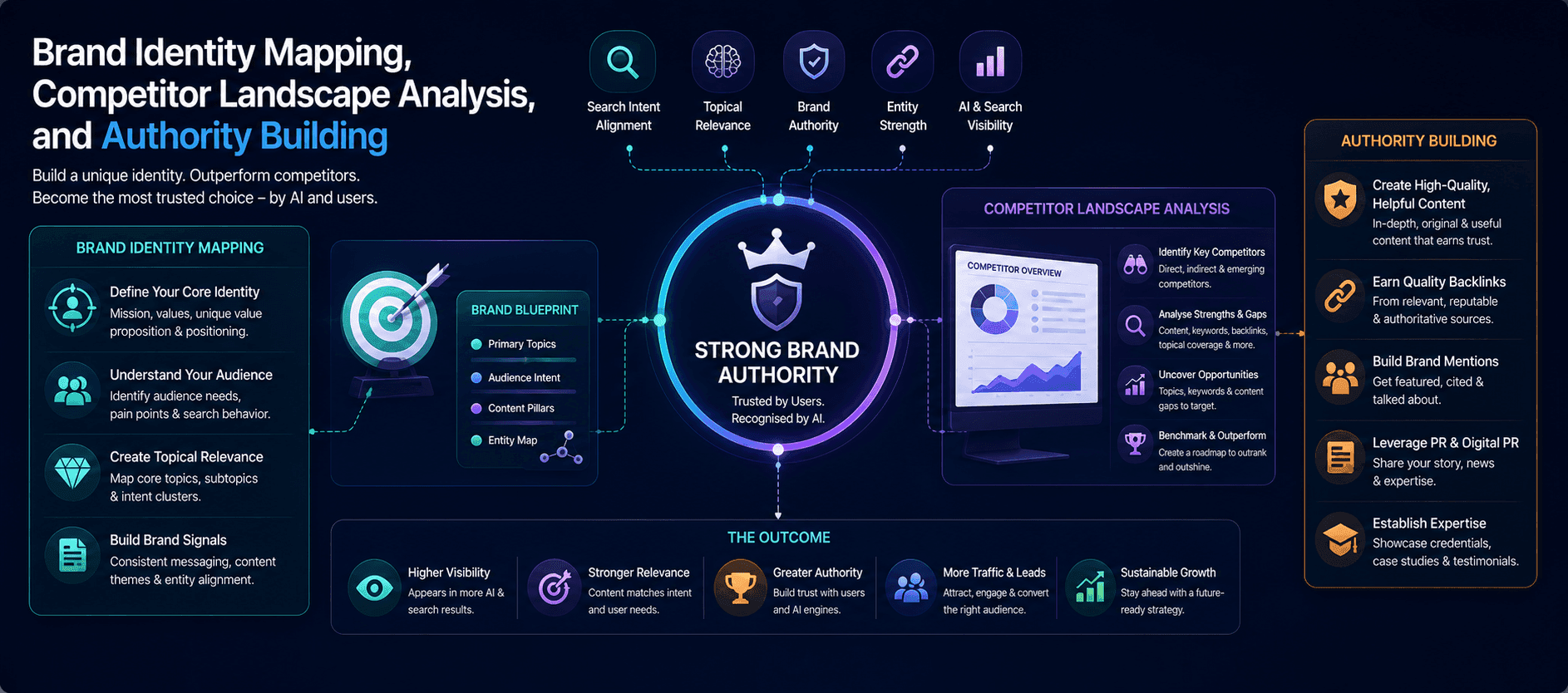
The problem: AI models maintain an understanding of entities: brands, people, organisations, and their relationships. If your brand is not well-established in the knowledge graph, AI models will not confidently cite you regardless of content quality. Most businesses also have no clear picture of how competitors are performing across AI platforms or where the citation gaps are largest.
What we do: Brand identity mapping starts with a SEMrush-driven audit of your entity presence and topic authority. We identify the topic clusters and citation opportunities your brand should be owning, and use those gaps to inform the prompt expansion strategy. A full competitor landscape analysis then maps which brands are being cited across ChatGPT, Perplexity, Google AI Overviews, and Gemini for your priority queries, what content is driving those citations, and what the authority gap looks like. Authority building covers the third-party ecosystem AI models use as trust signals: Clutch, Trustpilot, GoodFirms, Google Business Profile, and category-specific review platforms. Guest posts on DA 50+ publications, press releases on DA 75+ platforms, and contributions to Quora and Reddit build the off-site citation footprint LLMs treat as credibility evidence. The more consistently your brand appears as a credible source across authoritative platforms, the more citable it becomes in AI-generated answers.
Pro tip - Clutch, Trustpilot, and Google reviews are not just reputation tools. AI models actively reference review platforms as credibility signals when deciding which brands to cite. Review volume and recency on these platforms is a direct input to AI citation rate.
Prompt Expansion Strategy
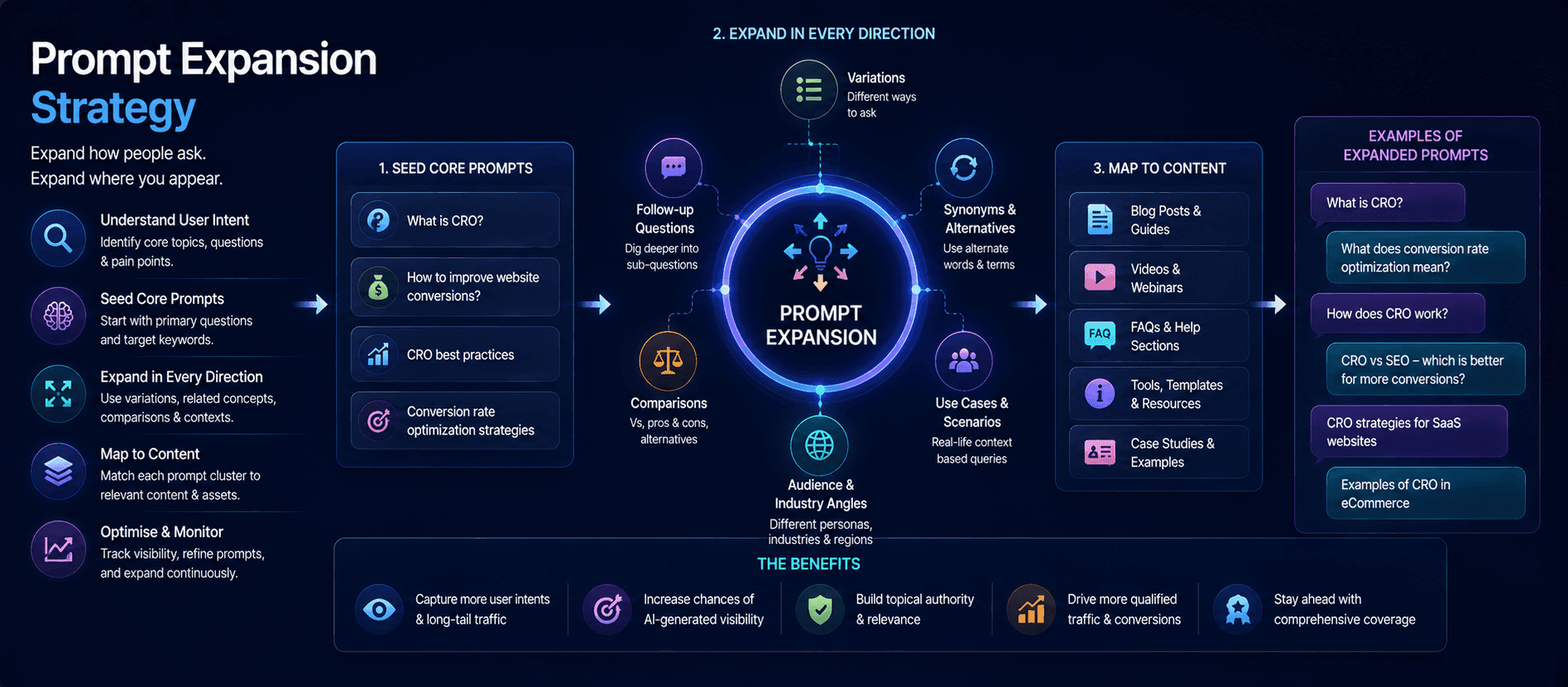
The problem: Most businesses think in keywords. AI buyers think in prompts. A prompt is not a keyword: it is a complete question or scenario, often in full sentences. "Which digital marketing agencies in Bangalore have experience with D2C brands and can show me case studies" is a prompt, not a keyword. Optimising for prompts requires a different approach entirely.
What we do: Prompt mapping across the full buyer journey. We identify the specific questions your buyers are asking AI tools at each stage: awareness ("how do I grow my business online"), consideration ("what does a good performance marketing agency do"), and decision ("which agencies in Bangalore have worked with real estate brands"). We then engineer content that answers those prompts comprehensively enough to be cited. The content does not just mention the right words. It demonstrates that your brand is the answer to the specific question being asked.
Pro tip - Prompt expansion is the most direct path to appearing in AI answers for decision-stage queries where the buyer is close to choosing a vendor. This is where AI SEO produces the most immediate commercial impact.
AI Visibility Tracking and Reporting
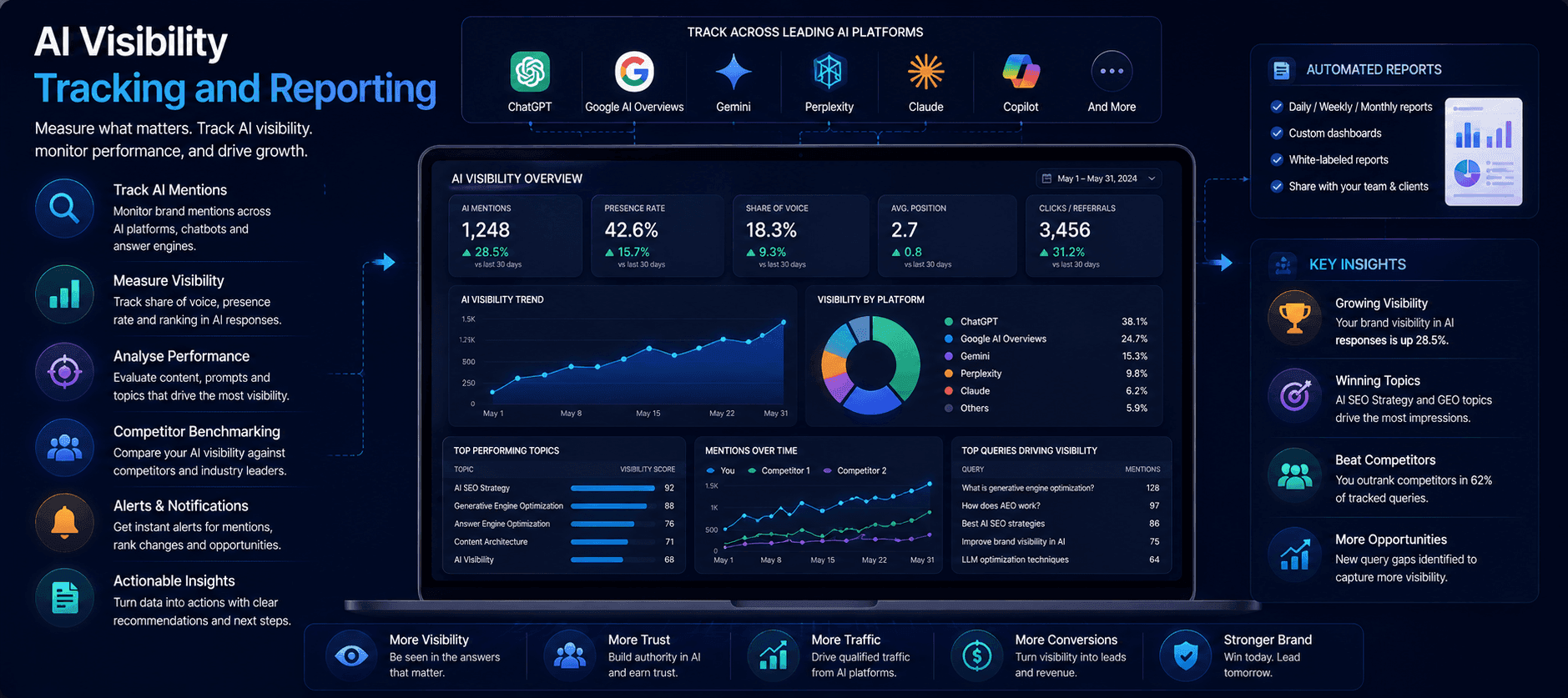
The problem: Traditional SEO metrics, rankings, traffic, and conversions, do not capture AI visibility. A brand can be cited in ChatGPT answers thousands of times per month and see none of it in Google Analytics. Most businesses have no way of knowing how visible they are in AI-generated answers or whether their AI SEO investment is having any business-driven outcome.
What we do: AI visibility tracking covering brand mention frequency across AI platforms, citation rate by prompt category, AI-referred traffic in GA4, featured snippet and AI Overview inclusion rate, and brand mention sentiment on peer-to-peer platforms. KPIs tracked: AI visibility score, brand mentions across AI platforms, citation frequency, and AI-referred session volume. These are reported alongside traditional SEO metrics so the full picture of search visibility across both channels is visible in one place. Monthly reporting covers what changed, why, and what we are adjusting.
Pro tip - AI visibility tracking in month one is the only way to prove the lift once optimization begins, since AI citation volume has no historical benchmark like Google Search Console does. This is what turns "we think this is working" into a number a client can defend internally.
How We Build AI Visibility the Right Way
AI visibility is not a shortcut around SEO. It is SEO done with a more complete understanding of where search is going. Every AI AEO engagement starts with the same foundational diagnosis, because the foundation is the same.

AI Visibility Audit and Technical Foundation

Content Architecture and GEO Strategy

Execution

Reporting and Iteration
AI Search Visibility Looks Different in Every Category
The prompts buyers use in AI platforms are category-specific. A healthcare buyer asking Perplexity "what are the best fertility clinics in Bangalore" triggers a different sourcing logic than a SaaS buyer asking ChatGPT "what CRM should a 50-person B2B company use." The AI SEO strategy for each is different. We have worked inside these sectors and that context shapes what we prioritise.
AI SEO Services for SaaS and B2B Technology
SaaS buyers use AI to build feature comparison frameworks before engaging a vendor. ChatGPT and Perplexity are where evaluation happens. The prompt "best CRM for B2B sales teams in India" is a decision-stage query that a brand either appears in or misses entirely. AI SEO for SaaS focuses on comparison content, use-case depth, expert authority content, and full semantic coverage of the technical terminology your buyer uses when researching.
AI SEO Services for Healthcare and Clinics
Healthcare is YMYL (Your Money or Your Life) territory. AI models apply the highest E-E-A-T standards to medical content. The path to citations runs through doctor-authored content, credible third-party citations, schema markup declaring clinical expertise, and review volume on platforms AI models treat as trust signals. Bangalore clinics competing for "best [specialty] clinic in Bangalore" queries need both technical SEO foundation and GEO content built to healthcare E-E-A-T standards.
AI SEO Services for Real Estate
Real estate AI queries are hyperlocal and high-intent. "3BHK under 80L near Sarjapur Road" and "RERA-approved projects in Whitefield" are the prompts that produce serious enquiries. AI visibility here means local schema, Google Business Profile signals feeding Gemini, neighbourhood-level content, and original data on project launches, price movements, and possession timelines that Perplexity rewards with citations.
AI SEO Services for Education and EdTech
Admissions decisions are research-heavy and AI-assisted. Parents and students are asking ChatGPT "best IB schools in Bangalore" and Perplexity "IGCSE vs CBSE: which is better for engineering entrance." The brands cited in those answers capture consideration before the first school visit. AI SEO for education means programme-level content in question-answer format, original admissions data, and comprehensive coverage that positions the institution as the expert source on its own category.
AI SEO Services for D2C and E-Commerce
Product discovery is shifting from Google Shopping to AI recommendations. "Best protein powder for muscle gain under 2000 rupees" is increasingly a ChatGPT prompt. AI SEO for D2C means product comparison content, specification-level depth, credible review aggregation, and category expertise that positions a brand as the authority source when an AI decides which product to recommend.
AI SEO Services for Professional Services (Legal, Financial, Consulting)
High-trust categories where AI citations carry significant commercial weight. Being cited by ChatGPT for "best corporate lawyer in Bangalore" or "financial advisor for NRI investments" captures buyer intent at its highest point. AI SEO here means expert opinion content, original data and commentary, named authorship with verifiable credentials, and presence on Reddit and Quora where AI models look for community-validated expertise.
Don't Just Take Our Word For It
Hear from the founders, CMOs, and marketing leaders who partnered with us to turn their search visibility into measurable revenue.
"From our very first consultation, Saji and his team demonstrated a deep understanding of the unique challenges and opportunities within the medical field's digital landscape. They meticulously optimized our website, improving our visibility for key u..."
Dr. Mahesh K Dhanjee
Consultant Urologist

"We are really pleased with the Wisoft solutions team and the SEO services they have rendered for Royal Garden Centre. They have helped us at every step of our journey, explained all the concepts and the catches so that we were clear on the goals and ..."
Sagar Sawlani
Co-Founder

"We have hired Wisoft on 2 SEO projects for our group of companies and I truly appreciate their commitment and open line of communication to ensure results and client satisfaction. Working with them has been very collaborative and always focused on me..."
Anju Anil
Marketing Head

15 Years of SEO Is the Foundation AI Was Trained On
AI models learned to answer questions from the same web Google has been ranking for decades. The content that trained ChatGPT, Gemini, and Perplexity is the content SEO built: structured, authoritative, cited, and comprehensive. A team that has been engineering that content across Penguin, Panda, Hummingbird, Core Web Vitals, and the Helpful Content update has been building AI citability before AI search existed.
Wisoft has been operating since 2009. We have not pivoted to AI SEO because it is trending. We have extended what we have always done into the channel where search is evolving. The advantage we offer is not just knowledge of the new platforms, but 15 years of demonstrated competence in the foundational signals those platforms are built on. The businesses that adapt now capture first-mover advantage before the category saturates.
We fix the foundation first
AI citations on Google AI Overviews run directly through traditional rankings. We do not skip that step.
We track AI visibility as a primary metric
Brand mentions, citation frequency, and AI-referred sessions are reported alongside traditional traffic and ranking data.
We build for the platforms your buyers are actually using
The platform mix is mapped before the strategy is built.
We are honest about timelines
AI visibility compounds over months. Anyone promising AI citation results in 30 days is targeting low-competition queries or misrepresenting what is achievable.
On how we use AI in our own work
AI for SEO is as transformational as the digital camera was for photography. Digital cameras made exposure and capture effortless, which shifted the competitive advantage entirely to the photographer's eye: composition, story, perspective. We use AI to research faster, generate briefs at scale, and identify content gaps instantly. But we do not use it to produce content that sounds like every other AI-generated article. The edge is expert perspective, human nuance, and strategic value injected into content AI helped us structure but could not have produced on its own. We produce the best content, not the most.
Areas we serve in Bangalore
We provide services across every major Bangalore business and residential corridor:

What Bangalore Businesses Ask Before Investing in AI SEO
Other Blogs

Start With a Clear Picture of Where Your Brand Stands in AI Search
Our free AI visibility audit covers your current citation presence across ChatGPT, Perplexity, Google AI Overviews, and Gemini, the technical SEO gaps that are suppressing your AI inclusion rate, where competitors are currently being cited that you are not, and what a structured AI SEO programme would look like for your category.
No obligation. No generic recommendations. An honest assessment of your AI search visibility and what it would take to improve it.