
ChatGPT vs Google Search in 2026: What Search Optimization Services in Bangalore Must Now Deliver
Reading Time: 19 min
 Share this article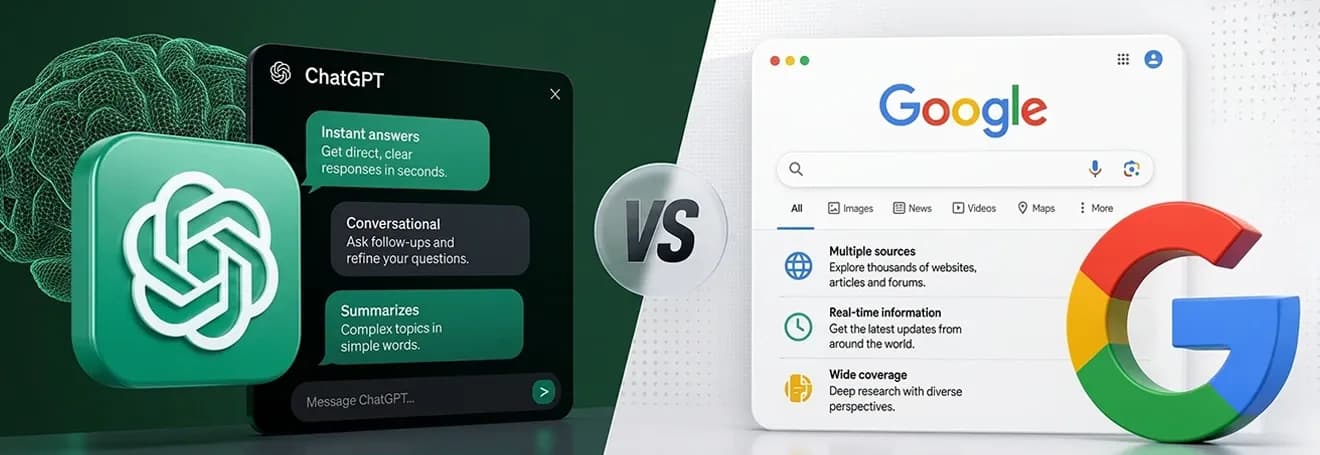
Key Takeaways
- ChatGPT and Google Search serve different purposes: Google Search helps users discover websites and sources, while ChatGPT focuses on generating conversational answers and assisting with problem-solving.
- AI is transforming search behavior: Users are increasingly moving from traditional keyword-based searches toward conversational queries and direct AI-generated responses.
- Google is evolving with AI-powered experiences: Features like AI Overviews and AI Mode show how Google is combining traditional search capabilities with generative AI to deliver faster, more contextual answers.
- ChatGPT provides personalized responses: Unlike traditional search engines that display ranked results, ChatGPT can summarize information, explain concepts, and adapt answers based on user interactions.
- Search accuracy depends on context and sources: Google remains strong for real-time information, local searches, and discovering verified sources, while ChatGPT excels in explanations, brainstorming, and content assistance.
Search behaviour is no longer confined to a list of blue links.
A potential customer might discover a company through Google, compare providers in ChatGPT, read reviews on another platform, return through a branded search and finally convert through WhatsApp or a contact form.
This does not mean Google has been replaced. Nor does it mean businesses need an entirely separate optimisation discipline for every AI platform.
What has changed is the journey between a question and a decision. Effective search optimization services in Bangalore must now help brands become discoverable, understandable and credible across both conventional search results and AI-generated answers.
This guide explains how ChatGPT and Google Search differ, where their discovery processes overlap and how businesses can build one sustainable visibility strategy for both.
ChatGPT vs Google Search for SEO: The Short Answer
Google Search primarily helps users find and evaluate web resources, although AI Overviews and AI Mode increasingly synthesise information directly within the results. ChatGPT provides conversational answers and may search the live web, cite sources and refine its response through follow-up questions.
For businesses, the practical answer is not “Google or ChatGPT”. It is:
Build an authoritative, technically accessible and evidence-rich digital presence that search engines and AI systems can retrieve, understand and confidently reference.
Traditional SEO remains the foundation. AI search adds new expectations around answer clarity, entity consistency, original evidence and coverage of complex conversational questions.
ChatGPT and Google Search Are Not the Same Type of Product
The comparison is useful, but it can also be misleading. Google Search is a search and discovery ecosystem. ChatGPT is a conversational AI product that can use web search when current or source-backed information is required.
Google also now provides generative experiences, including AI Overviews and AI Mode. As a result, the boundary between “search engine” and “answer engine” is becoming less rigid. Businesses must adapt by combining traditional SEO practices with AEO strategies to stay visible in the future of search..
| Area | Google Search | ChatGPT with Search |
|---|---|---|
| Main interaction | Queries and search results | Conversational questions and follow-ups |
| Typical output | Web pages, local results, products, videos, ads and generated summaries | Synthesised answer with source citations and links where search is used |
| Query behaviour | Often concise and keyword-led | Frequently detailed, contextual and task-led |
| Refinement | Users submit another query or apply filters | Users refine the same conversation |
| Local discovery | Strong integration with Maps, Business Profiles and local results | Can provide location-relevant answers using web search |
| Commercial discovery | Organic listings, paid ads, shopping and local packs | Recommendations, comparisons, cited resources and shopping experiences |
| Website requirement | Crawlability, indexability and eligibility for Search features | Public accessibility and permission for the relevant OpenAI search crawler |
| Measurement | Search Console, analytics, Business Profile and advertising platforms | Referral analytics, server logs, citation monitoring and conversion tracking |
| Primary user advantage | Breadth, navigational control and access to multiple result formats | Synthesis, explanation and iterative decision support |
The important distinction is that ChatGPT does not always search the web for every answer. When it does use search, answers can include inline citations and a sources panel linking users to the underlying websites, according to OpenAI’s explanation of ChatGPT Search
How Google Search Works in the AI Era
Google still depends on discovering, crawling and indexing accessible web content. Its AI features sit within this broader search infrastructure rather than operating as an entirely disconnected visibility channel.
Google explains that its generative search features use techniques such as retrieval-augmented generation and “query fan-out”. A complex question may be expanded into several related searches so the system can retrieve information covering different parts of the user’s need.
For example, a query such as “best CRM for a manufacturing SME in Bengaluru” might lead to related searches about:
- Manufacturing CRM requirements
- Indian data and integration considerations
- ERP compatibility
- Implementation costs
- Sales automation
- Vendor comparisons
- Customer support availability
A page does not have to repeat the original phrase endlessly. It must provide useful information for the wider problem represented by the query.
Google’s current guidance is particularly significant: traditional SEO best practices remain relevant to generative search because Google’s AI features draw upon its Search index and core ranking systems. Google also advises businesses to prioritise useful, non-commodity content instead of supposed AI optimisation shortcuts. See Google's official generative AI optimisation guide.
What Google still needs from a website
A website seeking visibility in traditional and generative Google experiences should provide:
- Crawlable pages and resources
- Logical site architecture
- Clear internal links
- Fast, usable mobile experiences
- Descriptive titles and headings
- Content that satisfies a recognisable need
- Accurate business and author information
- Structured data where it is genuinely applicable
- Original insights that add more than a summary of existing pages
- Strong alignment between the page, business and claimed expertise
AI does not remove these requirements. It raises the cost of publishing interchangeable content that offers no reason to select one source over another.
How ChatGPT Search Changes Content Discovery
ChatGPT can turn a user’s request into one or more web searches, retrieve relevant results and use those sources to compose an answer. The user can then ask follow-up questions without rebuilding the context from the beginning.
This creates a different discovery pattern.
A Google user might search:
- “SEO agency Bangalore”
- “SEO agency Bangalore pricing”
- “best SEO company for SaaS India”
A ChatGPT user might ask:
“Compare the qualities I should look for in a Bengaluru SEO partner for a B2B SaaS company expanding into the GCC. Include technical SEO, multilingual content and realistic measurement criteria.”
The second request contains industry, location, business model, expansion market and evaluation criteria. A generic “ten benefits of SEO” article is unlikely to satisfy it.
What ChatGPT Search needs from a website
OpenAI states that public websites can appear in ChatGPT Search. To improve eligibility for inclusion in summaries and citations, a site should not block OAI-SearchBot. OpenAI identifies this as the crawler used to surface websites within ChatGPT’s search features. See the official OpenAI crawler documentation and publisher guidance.
Technical access is only the starting point. A source also becomes more useful when it contains:
- Direct answers to specific questions
- Clearly attributed expertise
- Verifiable facts and transparent methodology
- Original examples, frameworks or data
- Descriptive headings
- Consistent business information
- Updated service and product details
- Clear distinctions between facts, opinions and recommendations
- Pages that remain understandable outside their immediate context
What most businesses miss is that being accessible to a crawler does not make a page citation-worthy. The page must contribute something useful to the generated answer.
Google Search vs AI Search: Where SEO Overlaps
The strongest strategy is built around common quality signals rather than separate content farms for every platform.
| Shared requirement | Why it matters |
|---|---|
| Technical accessibility | Retrieval cannot happen reliably if important content is blocked, hidden or dependent on fragile rendering |
| Clear information architecture | Logical relationships help users and machines understand services, industries, locations and supporting expertise |
| Entity consistency | Consistent names, addresses, services, authors and credentials reduce ambiguity |
| Original information | First-hand observations, methods and examples give systems a reason to select the source |
| Topical completeness | Supporting pages establish expertise beyond a single keyword-targeted article |
| Trust signals | Transparent ownership, authorship, policies and evidence support evaluation |
| Semantic clarity | Precise language makes passages easier to understand and retrieve |
| Freshness where necessary | Prices, regulations, software capabilities and market information can lose value when outdated |
| External reputation | Independent references and genuine reviews help validate business claims |
| User satisfaction | Useful pages are more likely to earn engagement, links, mentions and conversions |
The overlap is substantial. The difference is mainly in how users formulate questions and how results are assembled.
Where AI Search Optimisation Requires Additional Thinking
AI search optimisation is not a collection of formatting tricks. It is an extension of SEO into more conversational, multi-part and evidence-sensitive discovery journeys.
1. Optimise for the decision, not merely the query
Keyword research might identify “CRM software for small business”. Decision research asks what the business must know before choosing:
- Which departments will use it?
- Does it integrate with existing ERP software?
- Is WhatsApp communication required?
- What data must be migrated?
- How long will implementation take?
- What training is necessary?
- Which costs appear after the initial subscription?
Content that addresses the complete decision has more retrieval opportunities than a page focused on one keyword variation.
2. Make claims easy to verify
Avoid unsupported statements such as “we are the best” or “our strategy guarantees growth”.
Instead, document:
- What was changed
- Why it was changed
- How performance was measured
- Which limitations affected the result
- Over what period the observation was made
- Which evidence supports the conclusion
This strengthens human trust and makes the information safer for an answer system to reference.
3. Build reusable knowledge assets
A strong resource can contribute to many questions. Examples include:
- Original benchmark reports
- Service comparison tables
- Implementation checklists
- Cost calculators
- Glossaries
- Expert interviews
- Process diagrams
- Industry-specific templates
- Documented case studies
- Frequently updated regulatory guides
These assets can earn rankings, backlinks, citations, branded searches and qualified referrals.
4. Cover the surrounding entity network
A page about SEO for healthcare organisations should not mention “healthcare SEO” repeatedly and consider the task complete. It should connect the subject to relevant entities and concerns such as medical review, local discovery, practitioner profiles, patient privacy, appointment journeys and high-stakes content accuracy.
Entity coverage must reflect genuine subject knowledge, not a mechanically generated list of related terms.
The Dual-Discovery Framework
Businesses can use the following framework to align conventional SEO with AI search optimization strategies.
Layer 1: Access
Can search and AI retrieval systems reach the content?
Check:
- Robots.txt rules
- Meta robots directives
- HTTP status codes
- Canonical tags
- XML sitemaps
- JavaScript rendering
- Page speed
- Google indexation
- OAI-SearchBot access
- Internal orphan pages
Layer 2: Understanding
Can the system accurately identify the page’s purpose and relationships?
Check:
- One clear purpose per page
- Logical H1–H3 hierarchy
- Descriptive titles
- Clear service, industry and location relationships
- Consistent organisation information
- Relevant structured data
- Contextual internal links
- Unambiguous author and reviewer details
Layer 3: Evidence
Why should the information be trusted?
Add:
- Named authors or reviewers
- Relevant professional experience
- Sources for factual claims
- Publication and update dates
- Original examples
- Transparent case-study methods
- Clear policies and contact details
- Limitations where applicable
Layer 4: Answer Value
Does the page make the user’s task easier?
Include:
- Concise definitions
- Steps in a logical order
- Decision criteria
- Benefits and trade-offs
- Costs where reliable information is available
- Mistakes and risk controls
- Examples for different business contexts
- A clear next action
Layer 5: Demand Capture
Can the business convert discovery into a measurable relationship?
Connect relevant pages to:
- Service explanations
- Case studies
- Consultation forms
- CRM workflows
- WhatsApp Business
- Email follow-up
- Remarketing audiences
- Performance marketing campaigns
This final layer is often neglected. AI visibility has limited commercial value if the cited page offers no credible route from information to action.
A Decision Matrix for Content Investment
Not every topic requires a 3,000-word guide. Match the content format to the user’s task.
| User need | Best content format | Main optimisation priority |
|---|---|---|
| Learn a concept | Guide or glossary | Clear definition and examples |
| Compare approaches | Comparison page | Neutral criteria, trade-offs and table |
| Choose a provider | Service page plus buyer’s guide | Proof, process, fit and differentiation |
| Solve a technical issue | Troubleshooting guide | Ordered diagnostic steps |
| Estimate an investment | Pricing guide or calculator | Assumptions and transparent variables |
| Validate a company | About, team and case-study pages | Verifiable identity and experience |
| Find a nearby provider | Hyperlocal service page | Genuine local relevance and business details |
| Implement a process | Tutorial, checklist or template | Actionable sequence and required resources |
Consultant tip
Do not force informational, commercial and local intent into one oversized page.
A detailed guide can support a service page, but it should not replace it. The guide answers the subject-level question; the service page explains the company’s process, capabilities and suitability. A Bengaluru location page establishes genuine local relevance. Internal links connect the three.
How ChatGPT Affects SEO Content Strategy
The most visible change is not that long-form content suddenly wins or loses. It is that shallow content has fewer defensible advantages when an AI system can synthesise common knowledge from several sources.
Content that becomes more vulnerable
- Generic definitions
- Rewritten competitor articles
- Listicles without evaluation criteria
- Pages created only to insert exact-match keywords
- Advice without authorship or evidence
- High-volume AI content with no editorial contribution
- Location pages that merely replace one city name with another
Google warns that using generative AI to create many pages without adding user value may violate its policy on scaled content abuse. The issue is not AI-assisted writing by itself; it is publishing generic content and primarily to manipulate rankings rather than help users. Refer to Google’s guidance on generative AI content.
Content that becomes more valuable
- First-party research
- Expert analysis
- Detailed case studies
- Original photographs and demonstrations
- Tools and templates
- Carefully maintained knowledge bases
- Local market experience
- Multi-stage comparison resources
- Content that explains exceptions and limitations
- Pages that help readers make consequential decisions
What most articles do not explain
AI search can reduce clicks for simple questions while sending highly informed visitors for complex ones. Therefore, traffic volume alone becomes a weaker measure of content value.
Businesses should also measure:
- Qualified enquiries
- Assisted conversions
- Branded search growth
- Engagement with case studies
- ChatGPT and other AI referral traffic
- Citation presence for important questions
- Sales-qualified lead rate
- Organic visibility across the full topic
- Conversion paths involving WhatsApp, CRM or remarketing
A 90-Day Implementation Guide
The transition to SEO in the age of AI should begin with the existing website, not with mass production of new pages.
Days 1–30: Establish the baseline
- Audit crawling, rendering and indexation.
- Review robots.txt treatment of relevant search crawlers.
- Map existing service, location, industry and informational pages.
- Identify overlapping pages competing for the same intent.
- Check organisation, address, author and service consistency.
- Review Search Console, analytics and server-log data.
- Record current visibility for priority commercial and conversational questions.
- Identify content with claims that require sources or updating.
Quick win: Rewrite unclear page titles, introductions and headings so each important page communicates its purpose immediately.
Days 31–60: Strengthen the knowledge architecture
- Assign one primary intent to each page.
- Create topic clusters around commercially relevant services.
- Separate service, comparison, educational and local intent.
- Add internal links based on reader needs, not keyword quotas.
- Improve author, reviewer and company transparency.
- Convert internal expertise into checklists, frameworks and examples.
- Add structured data only where the visible content supports it.
- Consolidate or redirect thin, duplicate pages where appropriate.
Quick win: Interview sales and customer-service teams. Their repeated prospect questions often reveal more valuable topics than another keyword-volume export.
Days 61–90: Publish, distribute and measure
- Publish high-priority knowledge assets.
- Create supporting service and industry content.
- Distribute original insights through social media and email.
- Use performance marketing to test commercial messages.
- Capture enquiries through appropriate forms, CRM and WhatsApp journeys.
- Monitor rankings, citations, referrals and qualified conversions.
- Update content when new evidence or market changes justify it.
- Document which content assists actual revenue conversations.
Quick win: Add a concise executive summary to complex resources, followed by detailed evidence and implementation guidance. This serves decision-makers without reducing depth.
Common AI Search Optimisation Mistakes
Treating GEO as a replacement for SEO
Google explicitly describes optimisation for its generative search experiences as part of SEO. Technical quality, content usefulness and search eligibility remain fundamental.
Creating an llms.txt file and considering the work finished
Crawler access can matter by platform, but no single file establishes authority. Google states that it does not require llms.txt or special AI markup for inclusion in its generative search features.
“Chunking” every paragraph for machines
Clear structure helps readers and retrieval systems. Artificially reducing all content to disconnected answer fragments can damage context, argument quality and brand voice.
Publishing unsupported statistics
A precise-looking number without an identifiable source weakens trust. Use first-party data with methodology, cite a dependable authority or remove the claim.
Measuring only last-click organic traffic
Discovery may begin in an AI answer, continue through branded search and end through WhatsApp or direct traffic. Measurement should account for assisted journeys.
Building three articles inside one page
One page can be comprehensive without targeting several unrelated primary intents. If sections could satisfy distinct searches and support their own user journeys, create connected supporting pages instead of an unfocused mega-article.
When Professional Search Support Becomes Useful
A business may manage basic content updates internally. Professional support becomes more valuable when technical, editorial and commercial problems intersect.
Consider specialist assistance when:
- Important pages are not indexed consistently
- Several pages compete for the same queries
- Organic traffic does not produce qualified leads
- Service and local pages lack differentiation
- Developers, writers and marketing teams work from separate plans
- The company needs visibility across India and international markets
- Content cannot be connected reliably to revenue
- AI-generated publishing has created quality or duplication concerns
- The business needs integrated SEO, paid media, CRM and conversion tracking
The right search optimization services in Bangalore should not offer an isolated keyword campaign. They should connect technical SEO, information architecture, editorial expertise, website development and conversion measurement around business priorities.
For organisations with longer sales cycles, this can also involve CRM automation, WhatsApp Business API, SMS follow-up and performance marketing. These services are relevant only when they improve the journey from discovery to qualified conversation.
Business Checklist: Are You Ready for Google and AI Search?
Use this checklist before expanding content production.
Technical
- Important pages are crawlable and indexable
- Robots directives reflect deliberate choices
- Canonical tags are accurate
- Mobile usability is strong
- Pages load reliably
- Google and relevant AI search crawlers can access intended content
Content
- Every page has a defined search intent
- Introductions answer the central question quickly
- Content includes original expertise or evidence
- Claims can be verified
- Related pages are connected contextually
- Duplicate and obsolete content is controlled
Trust
- The organisation is clearly identified
- Authors and reviewers are appropriate to the subject
- Contact and policy pages are accessible
- Case studies explain methods and limitations
- Service claims match demonstrated capabilities
Measurement
- Search Console and analytics are configured
- Enquiry sources are recorded in the CRM
- AI referral traffic is reviewed
- Branded search is monitored
- Qualified leads matter more than raw sessions
- Content updates are tied to evidence
Frequently Asked Questions
Will ChatGPT replace Google Search?
ChatGPT is changing how people research, compare and understand information, but replacement is the wrong strategic assumption. Google offers traditional results alongside AI Overviews and AI Mode, while ChatGPT can search the web and cite sources. Businesses should prepare for a mixed discovery environment in which users move between search engines, AI assistants, social platforms, review sites and brand websites.
Is SEO still useful when users receive AI-generated answers?
Yes. AI search systems still need accessible, relevant and trustworthy source material. Google states that its established SEO practices remain applicable to generative search. SEO also supports visibility in maps, local results, products, images, videos and standard organic listings. The required evolution is towards stronger evidence, clearer entities, original expertise and measurement beyond simple click volume.
How does ChatGPT affect SEO for business websites?
ChatGPT increases the importance of answering detailed, conversational and multi-part questions. Generic keyword pages may offer less value when common information can be synthesised automatically. Business websites should publish original resources, maintain consistent company information, permit appropriate crawler access and create clear paths from cited information to services, case studies and enquiries.
Does a website need special AI schema to appear in AI answers?
There is no universal special “AI schema” that guarantees inclusion. Google says no special schema is required for its generative search experiences. Businesses should continue using supported structured data accurately because it helps search engines understand content and can establish eligibility for relevant rich results. Structured data must match visible page content and follow each platform’s guidelines.
Should content be written for keywords or conversational questions?
Use both as research inputs, but write for the underlying task. Keywords reveal demand and language patterns. Conversational questions reveal context, constraints and decision criteria. A strong page uses natural terminology while answering the complete need. It should not repeat exact phrases at the expense of clarity or divide one coherent answer into dozens of thin variations.
Can AI-generated website content rank on Google?
AI-assisted content can perform when it is accurate, useful, original and created for people. The risk arises when businesses generate large numbers of pages without meaningful value, editorial control or expertise. Google’s policies focus on content quality and scaled abuse rather than banning a particular production tool. Human review, fact-checking and genuine information gain remain essential.
How can a business track traffic from ChatGPT?
Review analytics referral data, landing-page performance and server logs where available. Add CRM source fields and ask qualified prospects how they discovered the company. Monitor branded search, assisted conversions and engagement with cited resources. Referral traffic alone may understate influence because a user can discover a brand in ChatGPT and later return through Google or direct navigation.
What should businesses look for in an SEO partner in Bengaluru?
Look for technical competence, transparent methods, strong content judgement and a clear connection to business outcomes. The provider should understand local and international discovery, explain how pages support different search intents and avoid guaranteed-ranking claims. It should also integrate SEO with development, analytics and conversion systems when those capabilities are necessary for measurable growth.
Conclusion
The practical lesson from Google Search vs AI search is not that businesses must choose a winner. Both experiences depend, in different ways, on information that can be accessed, understood and trusted.
The strongest strategy combines technical SEO, original expertise, clear information architecture, verifiable evidence and an effective conversion journey. It also recognises that a citation, ranking or visit is an intermediate outcome—not the final business objective.